ESG / CSR-ready execution
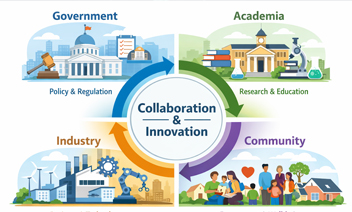
Government–Academia–Industry interface
SDG 2030 + Viksit Bharat 2047

Industry & CSR Partnerships that deliver measurable impact — not just spend.

Research Heights Foundation (RHF) enables corporates and PSUs to convert CSR/ESG budgets into high-trust, evidence-backed outcomes through Higher Education Institutions (HEIs): TRIIMPACT Centres of Excellence, campus-to-community pilots, skilling, research CSR, and transparent impact reporting aligned to BRSR and global SDG frameworks.

RHF is a Section-8 neutral integrator building Research–Innovation–SDG Centres of Excellence and Digital Research Infrastructure (DRI) across Tier-2/3 institutions — designed to improve real outcomes and also strengthen NAAC/NBA, NIRF (SDG Category), and THE Impact visibility.
What Corporates Get

A single, trusted execution partner that converts CSR and ESG commitments into measurable outcomes, audit-ready evidence, and credible public reporting.

Industry-Linked SDG CoEs & Applied Labs

CSR priorities translated into working labs, research, and skill development.

Village & Community Pilots with Verifiable Impact

Time-bound pilots with baselines, targets, and geo-tagged evidence.

BRSR & Board-Ready Reporting

Dashboards, utilization support, and audit-ready ESG documentation

Most CSR fails at one place: credible execution + measurable outcomes + transparent reporting. RHF is built exactly for that gap.

Outcomes-first design

Baseline → targets → interventions → monthly evidence. You don’t fund “activities”; you fund outcomes aligned to SDG indicators and CSR Schedule VII themes.

Multi-stakeholder execution

RHF acts as the interface between Government, Academia, Industry, and Community — enabling fast approvals, coordination, and scale-ready replication.

Trust, compliance, audit-pack

Structured governance, CA-certified utilization support, evidence repository, and a reporting kit tailored to BRSR/ESG disclosures and board requirements.

CSR-ready
partnership offerings

Pick a model based on your CSR strategy: campus sustainability, community impact, skilling & employability, or research-led innovation.

SDG Centre of Excellence (CoE) / Lab
  • Problem-driven lab setup: Includes hardware, software, and specialized training programs.
  • Industry mentorship + curriculum integration: Alignment with NEP 2020 standards.
  • Student innovation: Focused on prototyping and a patents pipeline.
  • Visibility: Includes CoE inauguration, annual impact reports, and media kits.
Village / Community Adoption Program
  • College-led implementation in nearby villages (NSS / NCC + faculty teams)
  • Baseline survey + measurable improvements in water, energy, waste, and livelihoods
  • Community ownership via Panchayat / SHGs / FPOs
  • Quarterly ESG reporting + geo-tagged evidence
Green Campus & Net-Zero Pathway
  • Energy audits + retrofits (LED, sensors, HVAC, smart metering)
  • Rooftop solar, solar street lights, water heating, EV charging
  • Waste-to-value pilots + circular campus operations
  • Annual Climate / SDG report card (NIRF SDG, NAAC Criterion 7)
Skilling + Employability + Innovation
  • Industry-aligned skill tracks + micro-credentials
  • Capstone projects solving CSR / community challenges
  • Startup incubation support, demos, and placement linkages
  • Impact: youth employability + local problem-solving capacity

You get a predictable workflow with clear responsibilities, timelines, and evidence checkpoints.

5-step delivery model

01
Discover & shortlist

Identify themes, geographies, target institutions/villages; map to SDGs + CSR Schedule VII.

02
Design & sanction pack

DPR, budget, governance, procurement plan, KPIs, and reporting structure for internal approvals.

03
Execute pilot

Implementation with local teams; monthly evidence; issue resolution; stakeholder reviews.

04
Measure & report

Quarterly ESG reporting (BRSR-friendly), utilization support, third-party validations as needed.

Compliance & governance

Designed for CSR governance committees and ESG audit teams.

  • Tripartite MoU pack (Corporate–RHF–Institution / Govt partner where required)
  • Utilization & evidence repository (photos, geo-tags, bills, attendance, outcomes)
  • Quarterly review cadence + issue trackers + risk logs
  • Impact KPIs mapped to SDGs and internal ESG material topics
  • Recognition kit (events, signage, reports, stakeholder stories)
Baseline audits

Energy, water, waste, employability, and community needs — captured with standardized formats and readiness trackers.

Digital evidence trail

Geo-tagged photos, attendance, procurement records, utilization proofs, and outcome indicators — organized for audits.

Impact KPIs

Clear KPIs aligned with SDG indicators and ESG material topics — not vague narratives. Designed for quarterly board review.

Frequently Asked Questions

Clear, board-friendly answers before your CSR committee signs off.

RHF uses Higher Education Institutions (HEIs) as structured execution engines — faculty, students, labs, and governance systems — instead of ad-hoc NGOs or short-term vendors. Every project follows an outcomes-first model (baseline → targets → intervention → evidence), supported by digital evidence trails and audit-ready reporting aligned to BRSR, SDGs, and CSR Schedule VII. This results in lower cost per outcome, faster deployment, and higher credibility.

Each partnership includes a complete audit pack, consisting of:
  • Baseline assessment reports
  • Monthly geo-tagged photo and activity evidence
  • Utilization certificates and financial documentation
  • Outcome KPIs mapped to SDGs and ESG material topics
  • Quarterly BRSR-friendly ESG reports and an annual impact report suitable for board review and public disclosure

Yes. CSR programs can be geo-fenced to a specific state, district, or cluster of villages, and aligned to priority SDGs, CSR Schedule VII themes, or internal ESG materiality areas.

RHF shortlists local HEIs and community partners to ensure faster approvals, contextual relevance, and scalable replication within the chosen geography.

RHF operates with strong CSR governance controls, including:
  • Tripartite MoU (Corporate–RHF–Institution / Govt partner where required)
  • Defined roles, approval checkpoints, and escalation protocols
  • Quarterly review cadence with risk and issue trackers
  • CA-supported utilization documentation
  • Evidence repositories designed for statutory CSR audits and ESG assurance

The model is designed for scale from Day 1. Once a pilot is validated, the same framework can be replicated across multiple colleges, districts, or states with standardized dashboards, reporting formats, and governance structures.

Corporates can consolidate outcomes into a single annual impact report, supported by recognition kits, case studies, and media-ready narratives.