TRIIMPACT 2047 - SDG action where Education, Government & CSR meet.

A structured framework that unites Colleges, Government, and Corporate / PSU CSR to transform villages and communities through SDG-linked projects, aligned with NEP 2020, UN SDG 2030, and Viksit Bharat 2047.
A national-scale execution framework for SDG outcomes - not a campaign.

TRIIMPACT 2047 is a structured government-academia-industry execution model that converts policy intent, CSR capital and academic capability into measurable, auditable SDG outcomes. Higher-education institutions act as local innovation engines, CSR/PSUs fund well-defined interventions, governments enable convergence and scale, and Research Heights Foundation (RHF) functions as the neutral Program Management Unit (PMU) — ensuring discipline, evidence and continuity.

Baseline - Intervention - Evidence Pack - Quarterly ESG Report - Annual SDG Report Card
Pilot design (example)
State - District - College CoE - Village Projects
10 Phase-1 Colleges
20 Villages / Wards
5+ CSR / PSU Partners
10,000+ Students Engaged
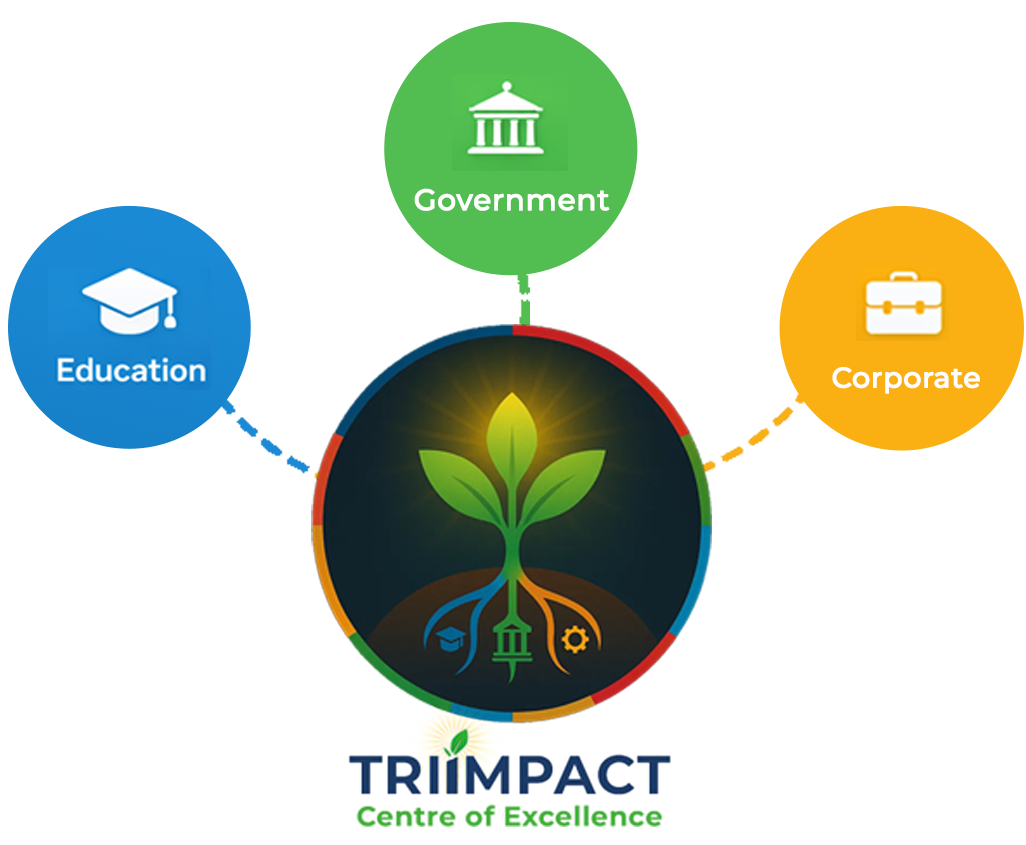
Education

Colleges and universities engaging students, faculty, and SDG labs to deliver real-world outcomes.

Government

State councils and departments aligning policy, schemes, and village-level implementation.

Corporate

CSR and ESG investments powered by technology, innovation, and impact measurement.

How TRIIMPACT is different

This is a programme-based execution framework—designed to survive audits, scale across districts, and generate ranking-ready evidence.

Typical CSR / SDG initiatives
Style

Activity-driven, one-off projects

Execution

Fragmented vendors and NGOs

Proof

Weak baselines and evidence trails

Reporting

Manual, inconsistent, slow

TRIIMPACT 2047
Style

Programme-based with governance & cadence

Execution

HEI CoEs, industry mentors & government convergence

Proof

Baseline → KPIs → digital evidence registry

Reporting

Dashboards, quarterly packs & annual report cards

The TRIIMPACT model

Three forces converge through RHF as a neutral integrator. Roles are distinct, accountable, and evidence-linked - enabling replication across districts and states.

Education (HEIs)

SDG CoEs, student clubs, research

  • SDG-aligned curriculum & CO-PO
  • Thematic labs & research
  • NAAC / NBA / NIRF evidence
Industry · MSMEs · CSR · PSUs

Funding, mentors & technology pathways

  • CSR funding for CoEs & pilots
  • Problem → prototype → deploy
  • Internship-to-hire pipelines
Government

Missions, recognition & scale

  • State & district facilitation
  • Mission convergence
  • Public accountability dashboards
PMU (RHF)

Integrator + program governance

  • Framework & onboarding
  • Dashboards & compliance
  • Evidence & reporting cadence

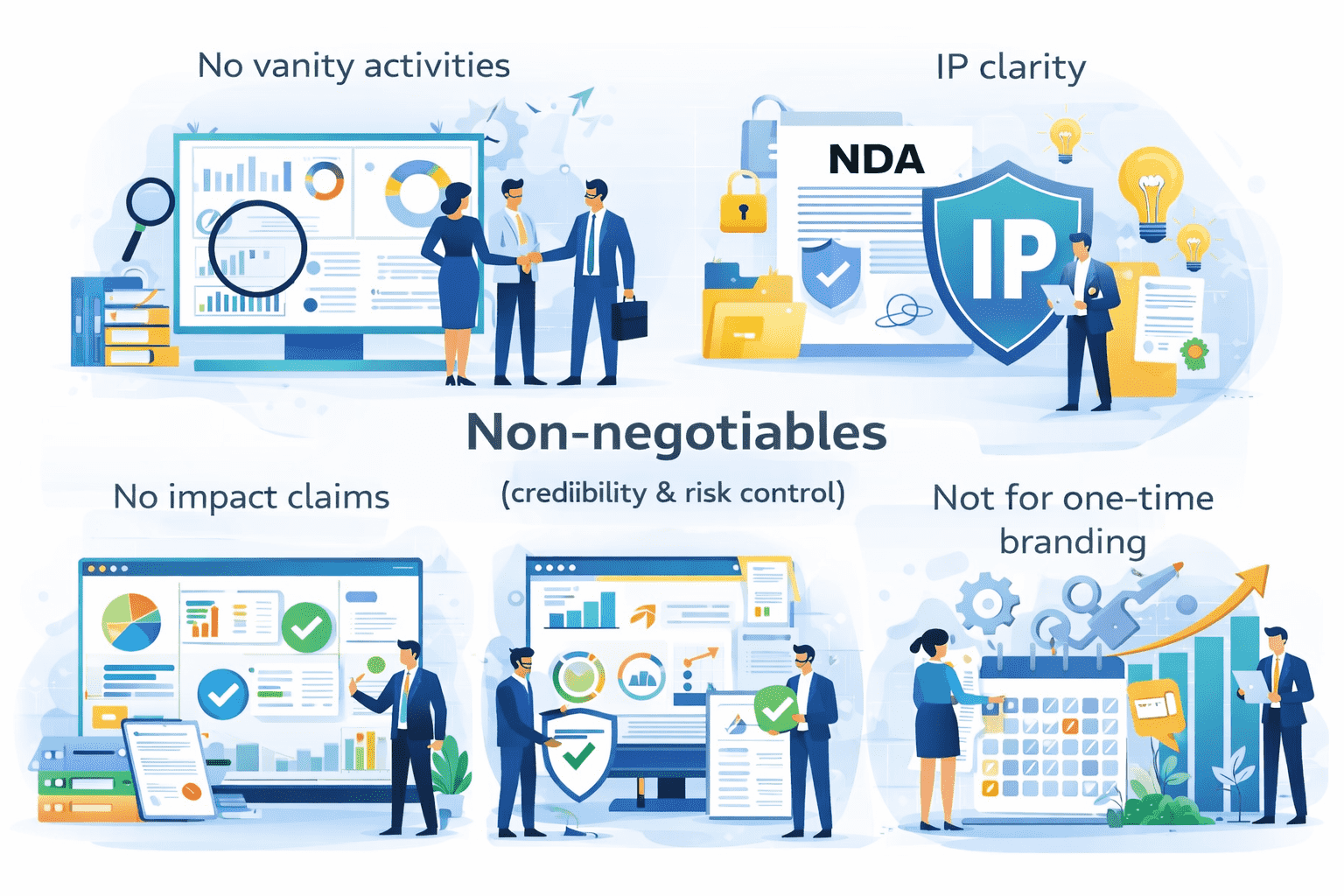
Non-negotiables (credibility & risk control)

  • No vanity activities: every intervention requires baselines, KPIs, evidence and documented outcomes
  • NDA-first option for sensitive industry data
  • IP clarity: partner retains IP unless mutually agreed
  • No impact claims without evidence and review
  • Not for one-time branding: this is a programme, not a sponsorship activity
Governance and Compliance

How it works

Simple stages, strict documentation, and clear accountability.

STEP-1

MoU & Governance

State/Dept + RHF set governance, reporting cadence, and districts.

STEP-2

CoE Onboarding

Select HEIs; create CoE themes, teams, and SDG clubs.

STEP-3

Partnering

CSR/PSUs fund packages; industry problems & mentors mapped.

STEP-4

Village / Campus Projects

Baseline → interventions → evidence capture → beneficiary logs.

STEP-5

Dashboards & Reports

Monthly tracker, quarterly ESG packs, annual SDG report cards.

Controls

Evidence checklist, beneficiary logs, geo-tagged photos, documentation standards and review cycles.

Reporting cadence

Monthly tracking for execution teams; quarterly reporting for CSR/PSU boards; annual public report cards.

Fund discipline

Clear scopes, sanctioned budgets, utilization reporting, and optional third-party verification/audit coordination.

Priority domains for industry & MSME collaboration

Fundable, execution-ready domains aligned to Indian industry, CSR priorities and SDGs. Configurable by state and sector.

Manufacturing & Industry 4.0

Process optimisation, quality, automation, energy efficiency and predictive maintenance.

Clean Energy & Climate

Solar, EVs, energy audits, carbon accounting and net-zero pilots.

Water & Circular Economy

Reuse, ZLD, segregation, recycling, plastics and e-waste systems.

Agriculture & Food Systems

Agri-processing, FPOs, cold chain, food safety and traceability.

Healthcare & Life Sciences

Medical devices, digital health, diagnostics and biomedical waste.

Digital, AI & GovTech

AI for SDGs, smart city pilots, IoT sensing, ESG data platforms.

Infrastructure & Built Environment

Green buildings, construction waste, mobility and urban resilience.

Skilling & Workforce Productivity

Apprenticeships, MSME skilling, women/youth employability pipelines.

ESG, BRSR & Compliance

Impact measurement, ESG dashboards, CSR monitoring and evidence registries.

Industry / MSME collaboration pathway

A practical on-ramp. Built to convert a problem statement into a pilot with baselines, KPIs, and evidence.

Pilot planning
What industry / MSMEs get in the first 90 days
  • Problem statement → pilot blueprint (scope, KPIs, timeline)
  • College CoE execution team mapped (faculty + students)
  • Baseline capture and intervention plan
  • Evidence pack (CSR / ESG / BRSR-friendly)
  • Scale-up note for management and CSR boards
Ways to engage
Ways to engage
  • Submit problems (process, quality, energy, waste, ESG)
  • Mentor student/faculty teams
  • Fund pilots via CSR / ESG programmes
  • Deploy tech (tools, sensors, platforms) as partners
Internship → hiring ESG outcomes Innovation pipeline
Manufacturing and MSMEs
Who should register
  • Manufacturing industries (process, quality, energy, waste)
  • MSME clusters and industry associations
  • Tech partners (AI / IoT / clean-tech / gov-tech)
  • PSUs and CSR foundations seeking measurable outcomes
Confidentiality and IP
Confidentiality & IP
  • NDA-first engagement available
  • IP remains with originating partner unless agreed
  • Public reporting only with partner consent

Government/state pilot pathway

A district-to-state model with governance, reporting cadence, and dashboards. Built for replication and public accountability.

MoU + Governance

Nodal department and districts; steering committee; reporting cadence and evidence standards.

District pilots

CoEs mapped to districts; village/ward projects; mission convergence; documented outputs.

State dashboard

State KPI dashboard, evidence registry, quarterly reviews and annual state SDG report card.

Why Research Heights Foundation (RHF)

RHF is not a vendor, contractor, or beneficiary. It operates as a neutral Section-8 integrator ensuring credibility, continuity, and delivery discipline.

What RHF does

Framework design, partner onboarding, CoE capacity building, dashboards, evidence systems, reporting, and casebooks.

What RHF is not

Not a vendor or contractor • not claiming ownership of CSR funds • not diluting partner visibility or credit.

Why it matters: Governments and CSR boards need an execution PMU that is neutral, evidence-driven, and continuity-focused — beyond one-off events.
Neutral program management and governance

Fundable packages (CSR / PSU-ready)

Designed for CSR and PSU approval workflows — with clear scope, budgets, timelines, KPIs and utilization reporting.

Village Impact Pack
₹10–20 L (indicative)
  • 1 village / ward (12–16 weeks)
  • Baseline + prioritisation workshop
  • 1–2 SDG interventions
  • Quarterly evidence pack
State Dashboard + Multi-Partner
₹50 L+ (indicative)
  • State KPI dashboard + evidence registry
  • Quarterly ESG reporting exports
  • Public visibility + annual state report
  • Optional third-party audit coordination

Dashboards & Evidence Backbone

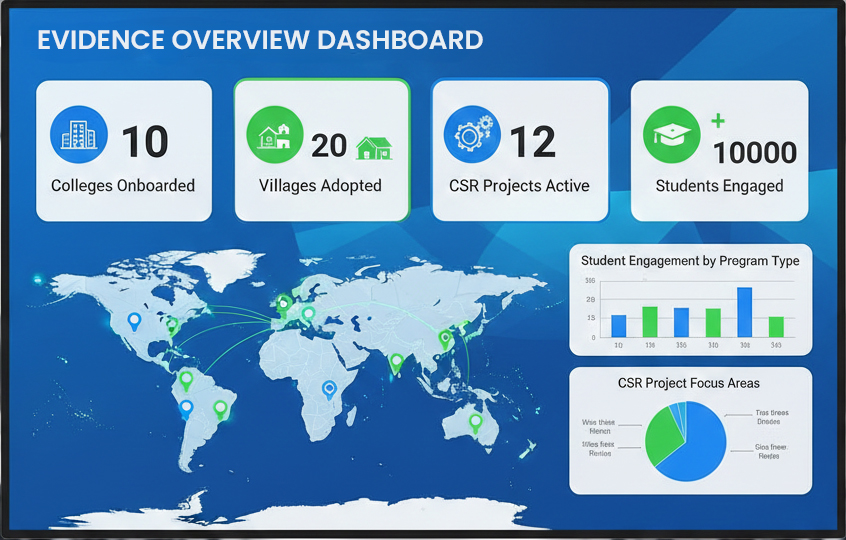
Trust is built through transparent data — funds, milestones, KPIs, and verifiable evidence trails across programs.

Colleges Onboarded

10

Villages Adopted

20

CSR Projects Active

12

Students Engaged

10,000+

What we track

Baselines • SDG mapping • budgets • milestones • photos/videos • beneficiary logs • MoUs • audit trail • report exports.

Ready-to-submit outputs

Monthly trackers • Quarterly CSR/ESG reports • Annual SDG scorecards • casebooks • media-ready impact summaries.

Dashboard Evidence System
Outcomes

Impact & KPIs – What We Will Measure

Trilmpact 2047 will maintain a live state-level SDG dashboard tracking outcomes across four major dimensions.

Climate
Climate & Environment
  • Estimated CO₂ reduction from solar, EVs and energy efficiency
  • Water saved, reused and harvested
  • Waste diverted from landfills; recycling metrics
Education
Education & Youth Engagement
  • Number of SDG projects, student teams and mentors
  • SDG integration into curriculum & CO–PO mappings
  • Startups, patents & research outputs
Community
Community & Livelihoods
  • Households benefiting from water, energy or livelihood projects
  • New SHGs / FPOs / FPCs supported via CSR
  • Income enhancement & risk reduction
Governance
Governance & Transparency
  • CSR fund utilisation efficiency & timeliness
  • NIRF SDG data completeness & NAAC criteria alignment
  • Joint policy notes, circulars & success stories

Why Now – Policy & National Context

A majority of HEIs still lack structured access to research infrastructure, CSR-linked projects and village partnerships. TRIIMPACT 2047 bridges this gap through a scalable, state-led collaboration model.

NEP 2020 & Viksit Bharat 2047

NEP 2020 mandates multidisciplinary learning, community engagement and institutional social responsibility. Viksit Bharat 2047 shifts higher education from degree-centric to impact-centric outcomes.

UN Sustainable Development Goals – 2030

Education is central to SDGs — especially SDG 4 (Quality Education), SDG 7 (Clean Energy), SDG 9 (Industry & Innovation), SDG 13 (Climate Action) and SDG 17 (Partnerships).

NIRF, NAAC & THE Impact

National and global rankings are shifting toward community outcomes, sustainability and climate impact. Institutions require structured, auditable SDG initiatives to remain relevant.

TRIIMPACT 2047 provides a single, evidence-driven platform that aligns policy mandates, funding mechanisms and institutional capacity into measurable national impact.

What’s In It For Each Stakeholder?

Trilmpact aligns incentives across government, academia, industry and experts through a single, structured, evidence-driven SDG implementation framework.

State Councils & Government

A unified, state-led SDG and youth engagement platform

  • State-wide mechanism to channel student energy & CSR
  • Evidence base for SDG reporting & climate planning
  • Improved data visibility across HEIs
Colleges & Universities

From isolated activities to recognised SDG Centres of Excellence

  • Support to establish SDG labs & CoEs
  • Improved NAAC, NIRF & global rankings
  • Student projects, internships & startups
Corporate & PSUs (CSR / ESG)

Credible, scalable SDG investments with transparency

  • Access to curated, ESG-aligned SDG projects
  • Real-time dashboards & third-party audits
  • Long-term village & community partnerships
Advisors & Experts

Influence national education-led SDG transformation

  • Shape a replicable state-to-nation framework
  • Support policy influence & consultations
  • Visibility through publications & impact reports

Role of Research Heights Foundation (RHF)

Research Heights Foundation is a Section-8, non-profit institution dedicated to building Research–Innovation–SDG Centres of Excellence, supported by strong digital research infrastructure for Indian higher education.

RHF within TRIIMPACT 2047

RHF functions as the neutral integrator and Program Management Unit (PMU), enabling states, institutions and CSR partners to collaborate through structured frameworks, digital systems and compliance-ready reporting.

Design & Architecture Lead

Develops implementation frameworks for SDG CoEs, SDG labs and village-level projects.

Digital Backbone Provider

Builds and manages state SDG dashboards, data pipelines and analytics platforms.

Research & Grants Partner

Maps funding calls, CSR opportunities and multi-institutional research clusters.

Capacity Building Partner

Trains faculty, students and administrators on SDG implementation and reporting.

PMU & Compliance Support

Provides documentation, CSR compliance, third-party audits and independent reporting.

How Advisors Can Engage With TRIIMPACT 2047

We seek 10–15 senior leaders from science, policy, higher education, CSR and development to contribute strategic guidance and national-scale mentorship.

  • Validate and refine the Trilmpact Telangana pilot design
  • Guide selection of priority themes, districts and villages
  • Enable access to national missions, ministries and global partners
  • Mentor a scalable national framework over the next 3–5 years
Validate & Refine

Strengthen the Trilmpact Telangana pilot design

Guide Strategic Selection

Identify priority themes, districts and villages

Open National Pathways

Connect with missions, ministries and global partners

Build a Scalable National Framework

Mentor national expansion over 3–5 years